

La Caja de los Sueños
This photographic series, staged within a theatrical box-like setting, explores the theory of the seven-year life cycles, known as the septennials.
The concept originates from the Theosophical and Anthroposophical worldview, according to which human beings gradually incarnate into different aspects of their being. It is rooted in the ancient idea that physical, mental, and spiritual development unfolds through successive seven-year cycles—a concept developed by the philosopher Rudolf Steiner.
Through this framework, Gildardo Gallo seeks to narrate the extraordinary experience of life from the perspective of consciousness. Drawing upon a profound reflection on his own personal journey and its synchronicity with the phases described by Steiner’s theory, the artist explores the defining experiences and transformations of each stage of life, from birth through the seventh septennial.
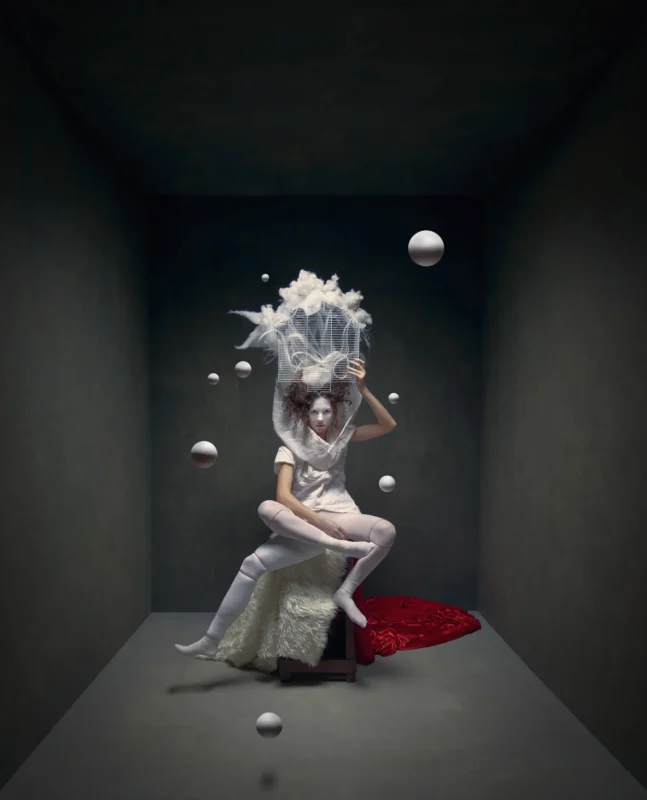
0–7 FIRST SEPTENNIAL
During the first septennial, which extends from birth to the age of seven, physical development is centered on the maturation of the neurosensory system. For the infant, the sense of touch—experiencing affection, care, and loving attention—is fundamental to development, as is hearing, particularly through the tone of voice. The young child is completely dependent on the surrounding environment, especially on the mother (the lunar element). The child absorbs the harmonies and conflicts that surround them, perceiving them through special “antennas.”
During this stage, the influence of the Moon is predominant, as it reflects all the cosmic impulses of the planets. Family values, often derived from religious traditions, inspire a sense of reverence. Throughout childhood, the family must offer love to the child to instill confidence and trust in the world. Kindness is the ideal of this septennial, because only a child who is loved will learn to love the world. Before birth, the human being accepts their own destiny (karma), which is necessary for future evolution.
At the age of three, the child begins to perceive themselves as an individual “I,” distinct from others. At this stage, the child is in the “age of imitation,” in which their being tends to reflect the surrounding environment, just as the Moon reflects the cosmic impulses of the planets. Here, moral impulses are introduced and received with reverence. Kindness is experienced within the family, and the child says to themselves:
“I feel loved, and people are good.”
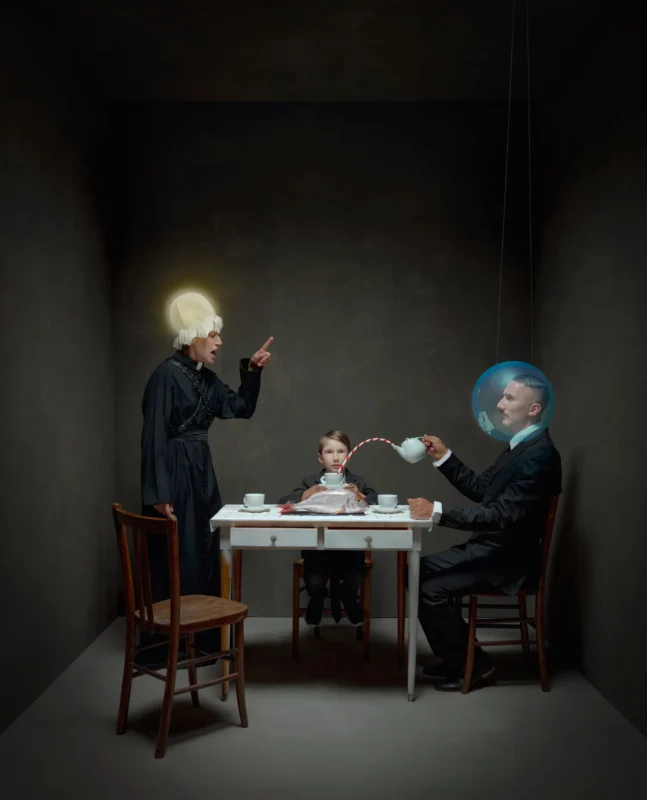
7–14 SECOND SEPTENNIAL
During the second septennial, which extends from the ages of seven to fourteen, the etheric forces are released from their enclosure and begin to bring vitality to the activity of thought and memory. On a physical level, the development of the organs connected to the rhythmic system is completed (heart, breathing, circulation). The transition from temporary teeth to permanent teeth also takes place.
This is the school-age period, in which the figure of the teacher and the relationship with peers acquire great importance. On an emotional level, strong currents of sympathy and antipathy are consciously experienced. Thought, the ability to relate, and communication skills begin to develop, as this septennial is under the influence of Mercury—the god associated with connection, exchange, and communication. During adolescence, the individual begins to experience the forces of good and evil within themselves. They feel drawn toward two extremes: great ideals on one side, and the darker aspects of reality and of their own inner nature on the other.
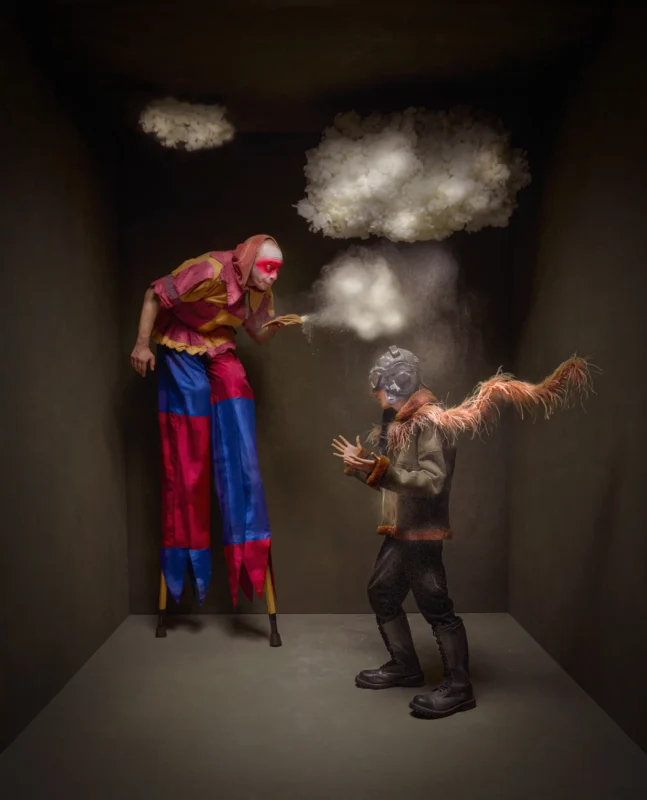
14–21 THIRD SEPTENNIAL
During the third septennial, which extends from the ages of fourteen to twenty-one, the development of the sexual organs and the limbs is completed, and the body reaches its full physical extension. The metabolic and regenerative systems continue to develop. With the effective birth of the astral body, the adolescent becomes capable of engaging with abstract concepts, no longer relying solely on knowledge based on images.
The young person begins to form their own judgment and approaches situations in which truth and falsehood can be experienced directly: the great ideals and the darker aspects of reality and of the self. It could be said that they experience the “expulsion from paradise.” This is the period in which sexuality awakens and the search begins for another person who can complete them—the companion. This septennial is under the influence of Venus, the principle of balance, harmony, and integration. With this, the first cycle comes to an end: the cycle influenced by the “gods” who passively determine karma, meaning the innate processes of development arising from natural or“collective” impulses, connected to the concept of the “ego.”
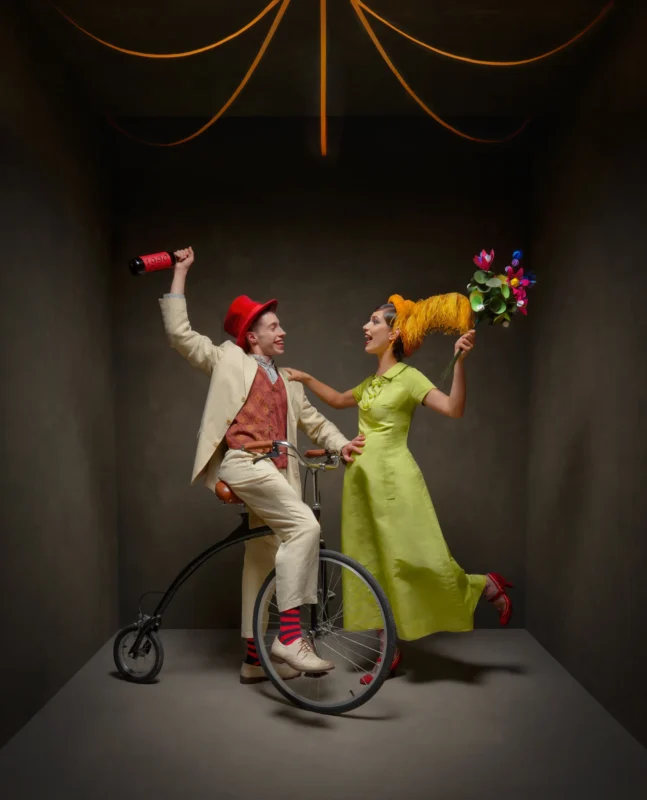
21–28 FOURTH SEPTENNIAL
This period is characterized by a transition from adolescence into early adulthood. Individuals are actively searching for their identity and attempting to find their place in the world.
Young adults begin to seek greater independence from their parents and authority figures. They may move away from home, begin living independently, or make important decisions regarding their education and career. Youth is a time of exploration and experimentation with different aspects of life, including personal values, beliefs, interests, and passions. This exploration may involve travel and the search for meaningful experiences.
During this septennial, many people begin to question their purpose in life and their long-term goals, seeking answers to existential questions and exploring different systems of belief. This septennial represents a crucial phase in personal development and in the formation of adult identity.

28–35 FIFTH SEPTENNIAL
The fifth septennial, which extends from the ages of twenty-eight to thirty-five, represents a continuation of the young adult phase.
During this period, the rational soul develops. This is often a dramatic moment in the inner life of the individual. Experiences in the external world are no longer sufficient on their own; they must be processed in order to extract their meaning.
Thought becomes predominant, and there is a search to give meaning to everything that has been experienced up to that point. Around the age of thirty-three, a person may experience a profound depression that leads to a deep transformation of character and behavior—a “struggle against the ego.” This event may occur slightly earlier (around the age of twenty-eight) or later (up to thirty-five), depending on the individual’s biography.
In a certain sense, the soul dies and is reborn within the “I.” When this renewal is complete, all experiences and knowledge are reorganized around individuality, so that the personality no longer dominates but assumes its role as an instrument. The “I” forms the rational soul through thought. This is the “age of working through experience,” in which the young adult must understand the experiences accumulated up to that moment, considering exclusively the forces of nature that acted within them to shape their physical, etheric, and astral bodies.
The “I” that is born within the soul allows the young adult to recognize their life mission for the first time. The energies are now dedicated to organizing knowledge, and the characteristic phrase of this stage is:
“I think.”
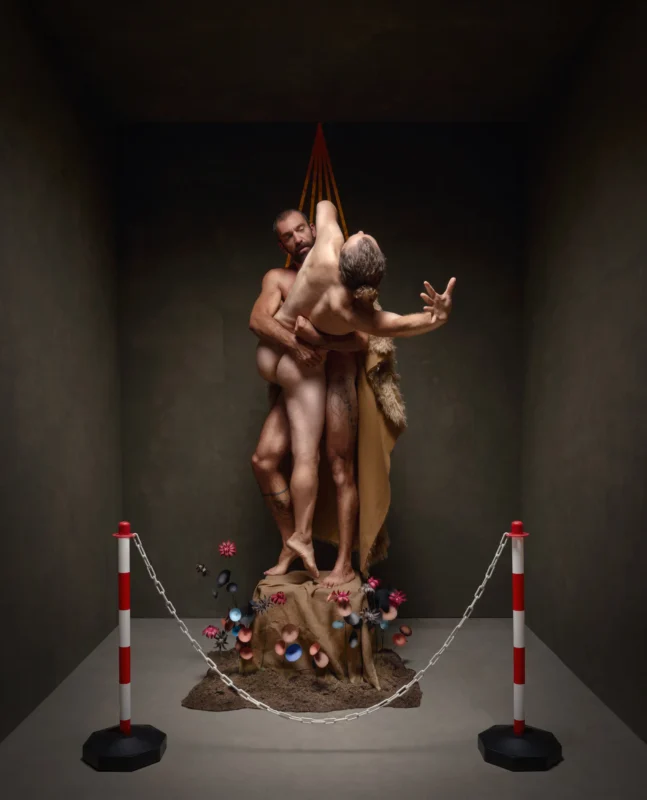
35–42 SIXTH SEPTENNIAL
During the sixth septennial, which extends from the ages of thirty-five to forty-two, the conscious soul develops.
Everything that has been dissolved and recreated within the crucible of the “I” must now flow outward into the world through action. At the beginning, this may be the most difficult septennial, as life must be completely reorganized according to new balances and foundations. Throughout this septennial, action leads to the discovery of the self. Finally, one understands that our actions carry responsibility.
What was spiritually sown before the age of twenty-seven begins to emerge in the form of projects that, when they mature, embody ideals. The “I” forms the conscious soul through will. This is the “dark age of solitude,” in which the adult reconstructs their world based on new individual values. Ultimately, something entirely new is brought into the world through this impulse of resurrection.
The adult must enter into action and assume responsibility, repeating the phrase:
“I will do it.”
Both work and responsibility allow the adult to encounter themselves through others, who stand before them with a question corresponding to the answer contained within their conscious soul. These are the first six septennials of human development. Each stage represents a unique opportunity for growth and transformation, marked by significant physical, emotional, and mental changes.

42–49 SEVENTH SEPTENNIAL
During the seventh septennial, which extends from the ages of forty-two to forty-nine, the Spirit of Man develops, prefiguring the sixth epoch, or the epoch of the Seven Seals.
During this period, the evolution of the Spirit of Man is anticipated, and there is a search to create a spiritual community based on the spiritualization of the family. Intuition develops, understood as love acting as a cognitive force. At the age of forty-nine, the individual karma of this incarnation reaches its limit, and any remaining karma must be balanced in future incarnations.
The “I” begins to work through the physical body in order to form what will become the third aspect of the spirit: the Spirit of Man. This period represents a conscious recapitulation of the first septennial, in which kindness is experienced through relationships with others.
Reverence for cosmic and divine forces acquires a practical dimension, thus realizing the brotherhood of the spirit, expressed through a spiritual community. To achieve this, it is necessary to develop intuitive consciousness, which implies thinking of living beings and recognizing ideas as living beings with which a human relationship can be established.
This seventh septennial marks an important point in human development, where the individual has the opportunity to transcend their karma and move toward greater spirituality and a deeper awareness of themselves as a spiritual being.
